

Global Electric Boat Market Set to Surge to USD 20.9 Billion by 2035 as Marine Electrification Revolution Takes Hold
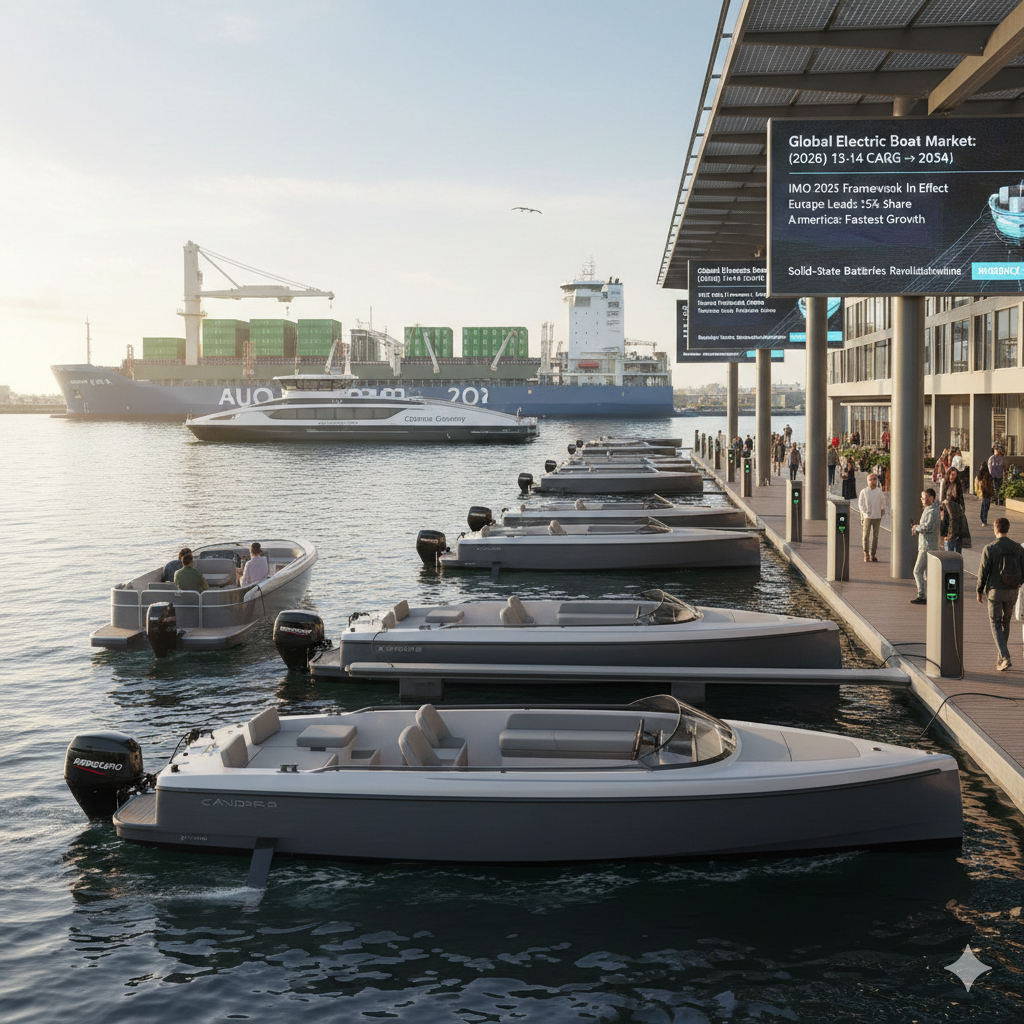
Electric Boat Industry
The electric boat market is projected to grow from USD 7.7 billion in 2025 to USD 20.9 billion by 2035, at a CAGR of 10.5%.
NEWARK, DE, UNITED STATES, January 30, 2026 /EINPresswire.com/ -- The global marine industry is standing at the threshold of a transformative decade. According to the latest market intelligence, the Global Electric Boat Market is forecasted to soar from USD 7.7 billion in 2025 to a staggering USD 20.9 billion by 2035, advancing at a compound annual growth rate (CAGR) of 10.5%.
This decade-long expansion promises to reshape everything from commercial ferry services to luxury recreational boating. Driven by a global push for zero-emission propulsion and rapid advancements in battery technology, the market is pivoting away from traditional diesel engines toward eco-friendly, silent, and high-efficiency watercraft.
A Two-Phase Propulsion Strategy
The market’s journey to 2035 is defined by two distinct phases of growth:
• 2025–2030: The Infrastructure Buildout: In the first half of the decade, the market is expected to reach USD 12.8 billion. This phase will be characterized by the rapid adoption of lithium-ion battery systems and the standardization of integrated electric drive trains. During this period, declining battery costs—projected to drop toward USD 80/kWh—will make electric boats increasingly cost-competitive with conventional diesel vessels.
• 2030–2035: The Ecosystem Maturity: The latter half of the decade will see the market climb to USD 20.9 billion, driven by mass-market penetration. This period will focus on the integration of autonomous navigation systems and the buildout of solar-powered marinas, creating a comprehensive, renewable marine ecosystem.
Request For Sample Report | Customize Report | Purchase Full Report
https://www.futuremarketinsights.com/reports/sample/rep-gb-5121
Commercial and Environmental Drivers
Three fundamental shifts are propelling this 10.5% CAGR:
1. Tightening Regulations: Maritime authorities, including the IMO and the California Air Resources Board, are implementing strict zero-emission mandates for protected waterways and harbors.
2. Total Cost of Ownership (TCO): Electric boats now deliver 60-80% lower energy costs and 70-90% lower maintenance costs compared to internal combustion engines. Commercial operators can expect payback periods of just 3–5 years.
3. Sustainable Tourism: Eco-tourism businesses are rapidly adopting silent, vibration-free vessels to access natural sanctuaries where diesel boats face operational bans.
What are the Drivers, Restraints, and Key Trends of the Electric Boat Market?
Growth Accelerators: Marine environmental regulations drive primary electric boat adoption as port authorities and waterway management agencies worldwide implement zero-emission zones protecting coastal ecosystems, with Venice prohibiting diesel boats in inner canals from 2028, Norwegian government mandating emission-free fjord ferry services by 2026, and Chinese authorities designating 80+ scenic waterways requiring electric propulsion creating regulatory push for boat electrification across commercial and tourism applications. Research indicates marine diesel emissions contribute significantly to coastal air pollution with single commercial ferry emitting equivalent particulate matter as 50+ passenger cars, creating public health imperative driving clean propulsion mandates.
Growth Inhibitors: Initial capital costs challenge electric boat adoption as battery-electric propulsion systems command 40-80% premium over equivalent diesel engines when comparing upfront purchase prices, with 30-foot electric recreational boat priced USD 80,000-120,000 versus USD 50,000-70,000 for diesel equivalent creating affordability barrier particularly in price-sensitive recreational market despite superior lifecycle economics through fuel and maintenance savings requiring 3-5 year ownership to achieve cost parity. Range limitations constrain electric boat applications particularly for ocean-going vessels and commercial operations requiring extended range or weather safety margins, with typical electric boats operating 30-50 nautical miles on single charge versus 200-400+ nautical miles for diesel vessels creating operational restrictions limiting electric propulsion to short-route ferry services, protected inland waterways, and day-charter recreational applications rather than long-distance cruising or offshore commercial operations.
Market Evolution Patterns: Adoption accelerates in protected waterway applications where range requirements remain modest and environmental regulations prove stringent, with geographic concentration in Scandinavian countries implementing aggressive marine electrification, European inland waterways enforcing emission standards, and Asian tourist destinations prioritizing eco-friendly tourism transitioning toward mainstream adoption in commercial ferry services worldwide and recreational boat markets in environmentally progressive regions. Technology development focuses on solid-state battery innovations promising 50-100% energy density improvements over current lithium-ion technology enabling 100+ nautical mile range suitable for long-distance ferry services and offshore recreational cruising, hydrogen fuel cell systems providing unlimited range through liquid hydrogen fuel storage applicable to large commercial vessels and luxury yachts requiring extended cruising capability, and battery swapping infrastructure enabling rapid 'refueling'through standardized battery pack exchanges at marina facilities eliminating charging time constraints for commercial operators maximizing vessel utilization.
Analysis of the Electric Boat Market by Key Country
The electric boat market demonstrates extraordinary regional dynamics with Growth Leaders including China (12.1% CAGR) and India (11.0% CAGR) driving expansion through aggressive electrification policies and coastal tourism development. High-Growth Markets encompass Germany (10.4% CAGR) and the United States (9.7% CAGR), benefiting from marine environmental regulations and recreational boating market maturity. Steady Performers feature Spain (8.7% CAGR), France (8.0% CAGR), and United Kingdom (7.5% CAGR), where established marine industries and eco-friendly initiatives support consistent market expansion.
Market Segmentation & Leadership
The report identifies Pure Electric Boats as the dominant product type, currently capturing 87.8% of the market share. While Lead Acid batteries maintain a temporary lead due to initial cost-effectiveness, the shift toward high-density Lithium-Ion technology is accelerating, representing a USD 5.5–7.0 billion technology advancement pool.
Regionally, China leads global growth with a 12.1% CAGR, fueled by government mandates for inland waterways and domestic battery manufacturing giants like CATL and BYD. India (11.0% CAGR) and Germany (10.4% CAGR) follow as high-growth markets.
Key Industry Players
The competitive landscape is defined by innovation-led firms, including:
• FRAUSCHER BOOTSWERFT: Leaders in premium electric day cruisers.
• Vision Marine Technologies: Pioneers in high-performance electric outboard motors.
• Duffy Electric Boat Company: The established leader in North American recreational cruising.
• RAND Boats & Quadrofoil: Innovators in high-efficiency hull design and hydrofoil technology.
As the industry moves toward 2035, the focus will shift from simple propulsion to comprehensive fleet management and smart port integration, solidifying electric boats as the gold standard for 21st-century maritime travel.
Similar Industry Reports
Electric Fireplace Market
https://www.futuremarketinsights.com/reports/electric-fireplace-market
Electric Grills Market
https://www.futuremarketinsights.com/reports/electric-grills-market
Electric Stakebed Truck Market
https://www.futuremarketinsights.com/reports/electric-stakebed-truck-market
Sudip Saha
Future Market Insights Inc.
+1 347-918-3531
email us here
Legal Disclaimer:
EIN Presswire provides this news content "as is" without warranty of any kind. We do not accept any responsibility or liability for the accuracy, content, images, videos, licenses, completeness, legality, or reliability of the information contained in this article. If you have any complaints or copyright issues related to this article, kindly contact the author above.
